adidas · CRM Strategy
Under NDA. To request access write to 4mhaig@gmail.com
The programmes had been built in isolation over years, each owned by a different team and optimised for a different metric. There was no shared logic connecting them, no framework, and no question being asked about where a person actually was in their relationship with the brand.
As sole designer, I reframed the entire CRM strategy from programme-based to journey-based, building a shared framework around user intent rather than programme logic. From that I developed a scalable template system so global markets could execute consistently without reinventing the system. Delivered to senior leadership as the strategic foundation for the 2026 CRM roadmap.
2025 Q1–Q3: Email volume vs Net Sales by journey phase
A customer who had just made a purchase could receive a re-engagement email the same day. Someone actively comparing products might get nothing at all. The system had no awareness of where people actually were.
The data confirmed what users were already feeling: most of the volume was going to the moments that drove the least value. The problem wasn't too many emails. It was that the emails were designed around programmes, not people.
"You send me too many messages that say almost the same thing."
adidas user, 2025"You only show up when I'm ready to buy, not when I'm still deciding."
adidas user, 2025"Help me find what fits me and why I should sign up."
"Help me check if this is the right product, in my size, at a fair price."
"Help me complete smoothly, with the best price, no confusion."
"Deliver what you promised, support me, and recognise my loyalty."
"If I drift, remind me of meaningful value, not spam."
The shift was conceptual before it was operational. Instead of "which programme should we run?", the question became: where is this person right now, and what do they need? That reframe reorganised 33 programmes into 5 journey phases, each with a clear user intent and a defined communication purpose.
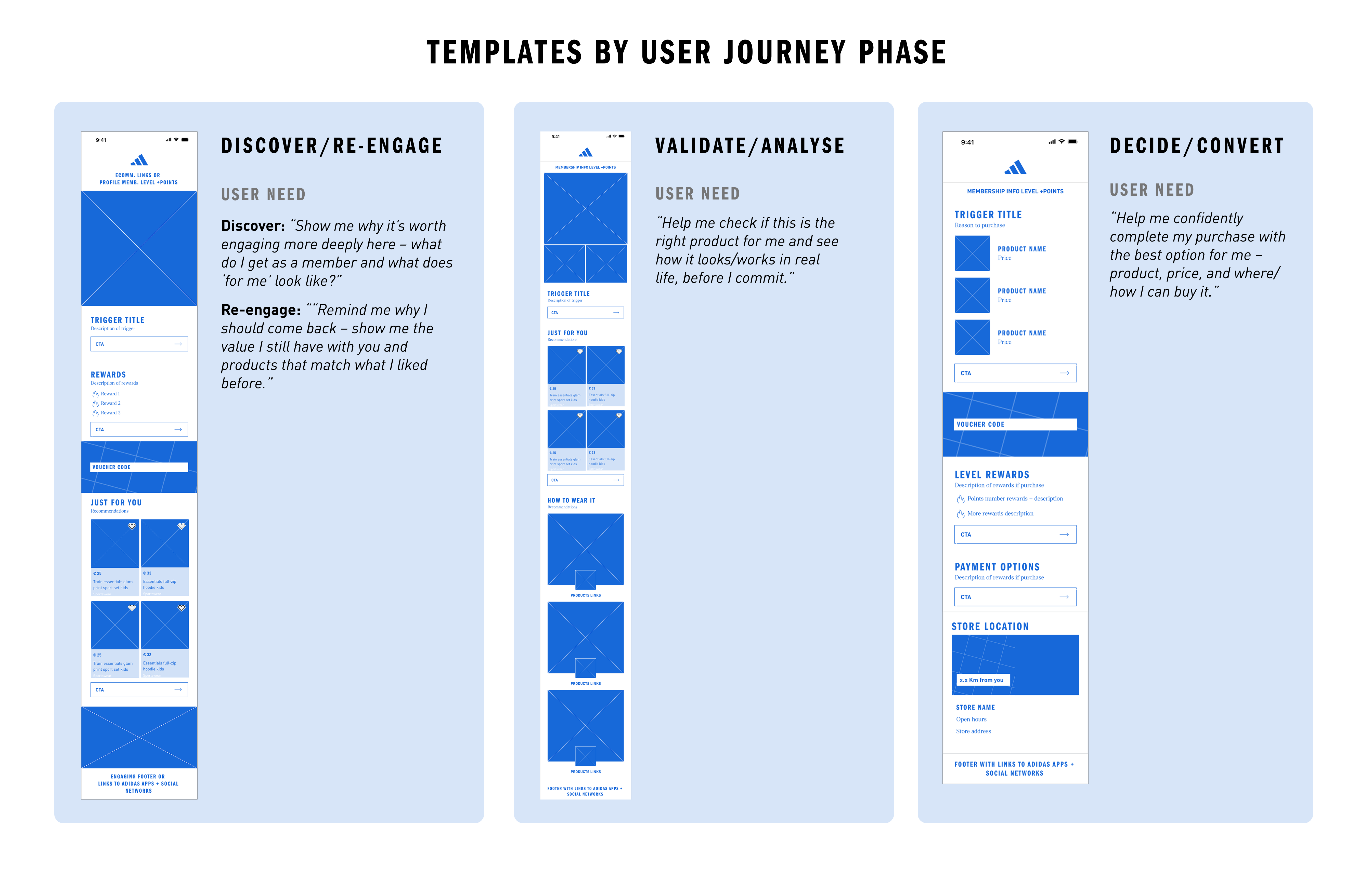
The programmes still existed, but now they lived inside a framework with shared logic. And from that framework came 3 templates: one per cluster of phases, each encoding the right tone, structure, and hierarchy, so global markets could execute without reinventing the system every time.
Templates by phase: Discover/Re-engage, Decide/Convert, and Validate/Analyse

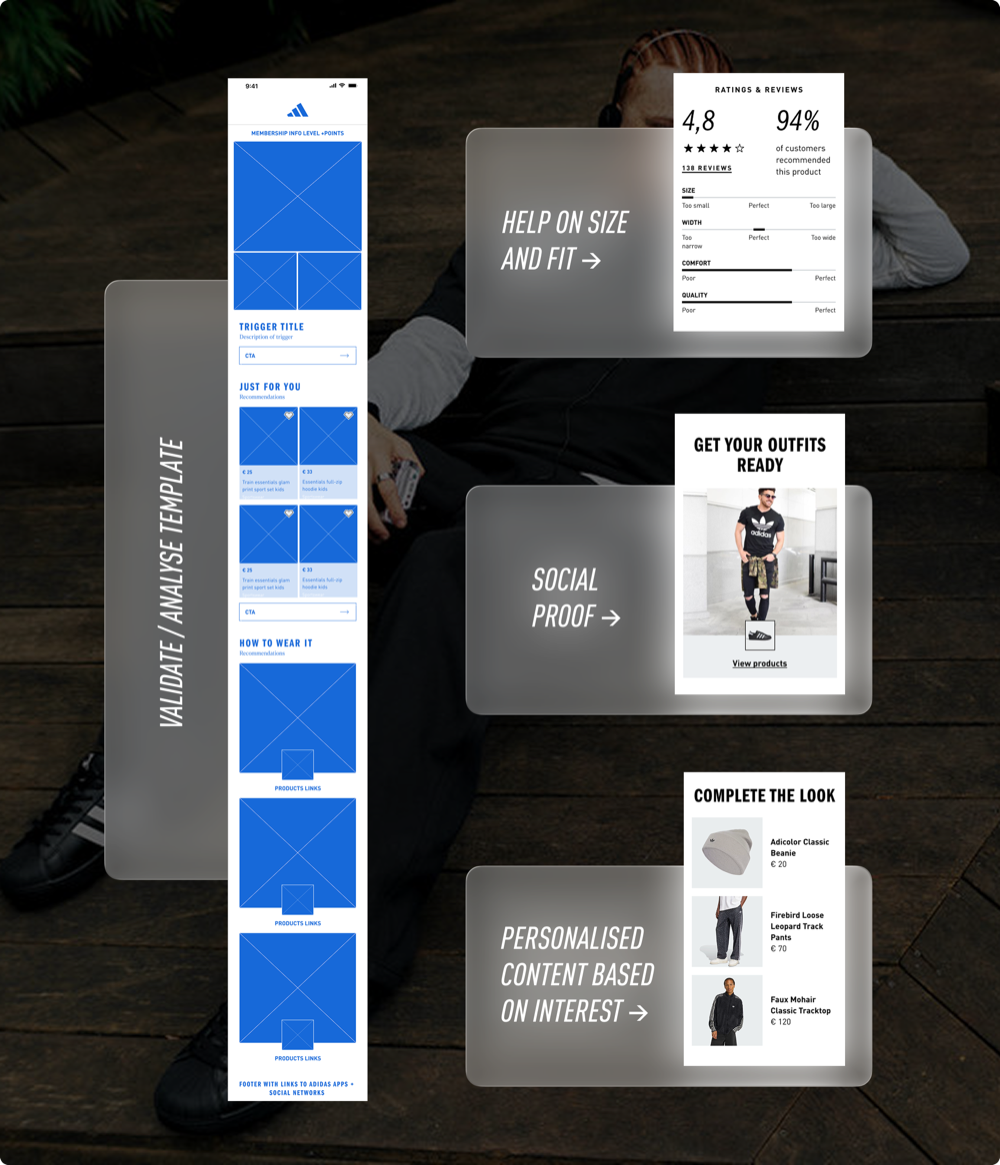
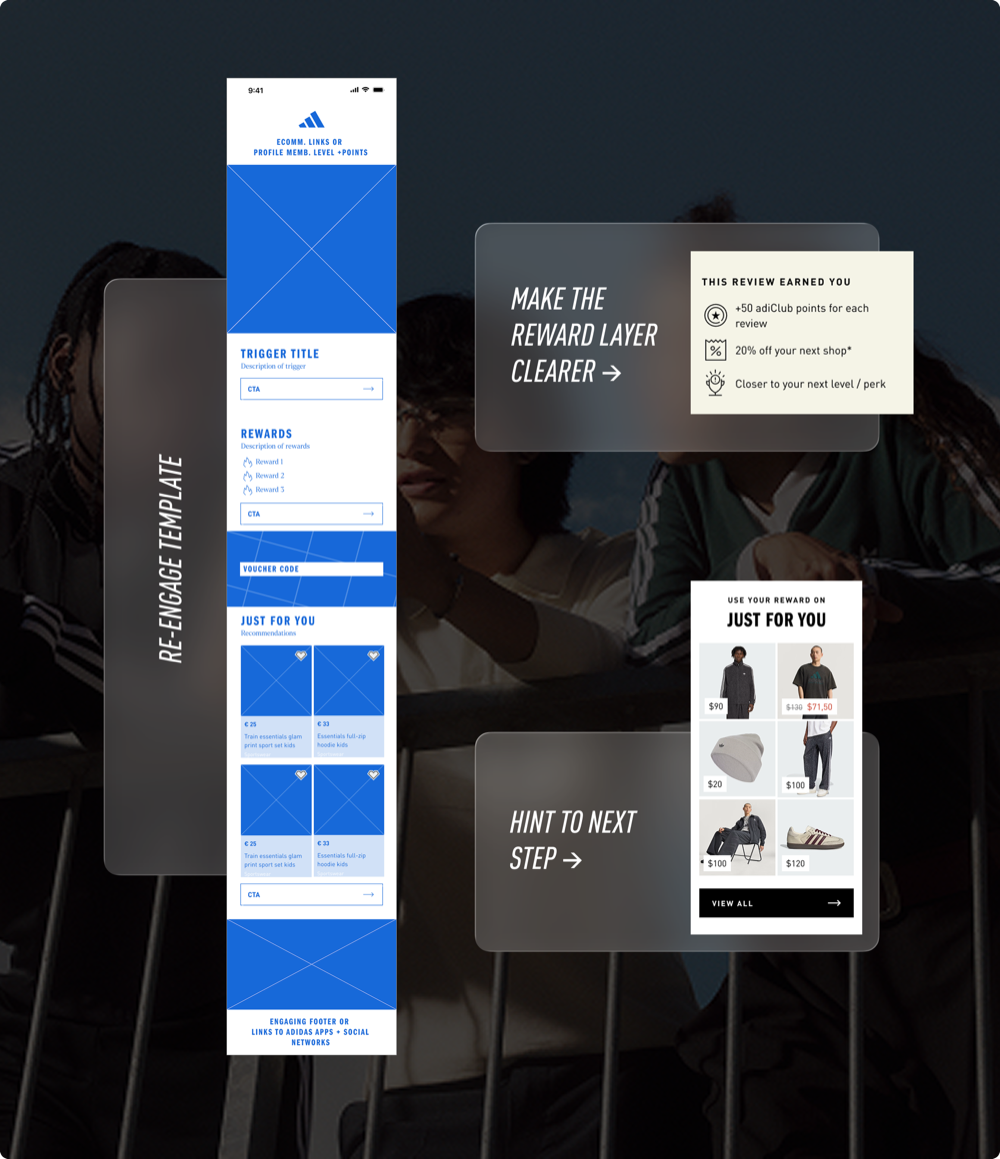
These are two of the three templates developed as part of the system, shown applied to specific programmes as proof of concept. Each template defines the structure, components, and tone for its phase. Any market team can adapt it without starting from scratch.
Only showing interest once the user is ready to buy
Help users be confident they're choosing the right product
Help on size and fit: surfaces the user's saved size and relevant fit guidance. Removes the main blocker at the comparison stage.
Social proof: ratings and reviews positioned at the decision moment, not buried at the bottom. Reduces uncertainty without adding pressure.
Personalised content based on interest: product image, price, and availability matched to what the user actually browsed. No generic recommendations.
Sending messages that feel generic and repetitive
Show recognition every time they deserved it
Reward layer visibility: points balance, tier status, and available perks surfaced prominently. Users need to see the value they have before they can act on it.
Hint to next step: a clear, single action that moves the user forward without overwhelming them with options. Progress framing over pressure framing.
Positive reinforcement tone: celebrates what the user has already done rather than warning what they'll lose. Language that builds the relationship instead of leveraging fear.
| Before | After | |
|---|---|---|
| Structure | 33 programmes, each owned in isolation, each optimised for its own metric | 5 journey phases, every programme lives within a shared system |
| Question | "Which programme should we run?" | "Where is this person, and what do they need right now?" |
| Tone | Loss-framing, pressure, urgency without value | Positive reinforcement: celebrate progress, earn re-entry, never threaten |
| Templates | Each team building from scratch, no shared language | Phase templates global markets can localise: the system becomes the briefing |
| Measure | Volume and open rates | Relevance and engagement quality: CRM as a trust channel, not a volume channel |